











English


Guide
Diablo IV Legendary Gear Recommendations




I used to keep every legendary that dropped. My stash filled up in about three hours of gameplay. Four tabs of "I might need this later" and "this aspect looks interesting." Then I spent an entire Sunday afternoon sorting through it all and salvaged roughly eighty percent of what I had been hoarding. That was the day I realized I had been evaluating legendary gear completely wrong.
Legendary items in Diablo IV are not just rares with an orange glow. They are the backbone of every build, and the decisions you make about which ones to keep, which to imprint, and which to feed to the Blacksmith have a bigger impact on your power progression than almost anything else in the game. What follows is not a list of "the ten best aspects." That kind of information goes out of date with every patch. Instead, what I want to share is the framework for thinking about legendary gear, because that does not change from season to season.
The Aspect Is the Item
When a legendary drops, most players look at the stats first. Item power, crit chance, main stat. I did this for an embarrassingly long time. Then I would glance at the aspect at the bottom like it was a bonus. That is backwards.
The aspect determines whether the item has any shot at being useful at all. A perfectly rolled ancestral chest piece with maximum life, armor, and damage reduction is vendor trash if the aspect on it does nothing for your build. The stats can be fixed with enchanting. The aspect cannot be changed once the item is imprinted. If the aspect is wrong, the item is wrong, no matter how good the numbers look.
There is an exception here, and it comes up more often than you would think: if an ancestral legendary has two or three greater affixes that are perfect for your build, but the aspect is useless, salvage it to bank the materials and upgrade your Codex if the roll is decent, then go find another legendary with the right affixes. Or, if the affixes are truly exceptional, imprint a good aspect from your Codex onto it. But that only works if you have not imprinted the item yet. Once imprinted, the item is locked to that aspect forever. So the order of operations matters: evaluate the aspect first, then the affixes, then decide what to do with the item.
Affixes That Actually Move the Needle
Not all affixes are created equal, and the in-game tooltips do a poor job of telling you which ones matter. I learned this the expensive way, burning millions of gold on enchanting rerolls chasing stats that added maybe two percent to my total damage.
Here is the hierarchy I use when evaluating a legendary's affixes. It is not universal for every class and build, but it holds true for most setups:
- Cooldown reduction goes on almost everything that can roll it. Helm, amulet, and focus or shield if you use one. More cooldown reduction means more uptime on your defensive skills, your mobility skills, and your ultimate. That translates directly to more damage and fewer deaths.
- Ranks to your core skill on gloves are non-negotiable. This single affix is often worth more damage than every other affix on the item combined. If your gloves do not have ranks to your main damage skill, they are probably wrong.
- Maximum life on chest, pants, and helm has become more important than it used to be. With the current damage scaling in higher content, having a deep health pool is what keeps you from getting deleted between cooldowns. Rings, by contrast, are your offensive slots. Prioritize crit chance, crit damage, attack speed, and resource generation there.
- Attack speed on gloves and rings changes how your build feels more than any damage number. Faster attacks mean faster resource generation, faster lucky hit procs, and faster cooldown reduction from effects that trigger on hit. Do not underestimate it.
- Movement speed on boots and amulet is not a luxury. It is a defensive stat disguised as a utility stat. Getting out of ground effects half a second faster prevents more damage than an extra ten percent damage reduction ever will.
There are build-specific exceptions to every rule in that list. A Thorns barbarian does not care about attack speed. A minion necromancer values minion damage over core skill ranks. The point is not to memorize a priority list. The point is to understand which affixes have multiplicative effects on your build and which are just adding flat numbers. Multiplicative stats like cooldown reduction, skill ranks, and attack speed are almost always better than additive damage percentages, even when the additive numbers look bigger on the tooltip.
Greater Affixes and Why They Changed Everything
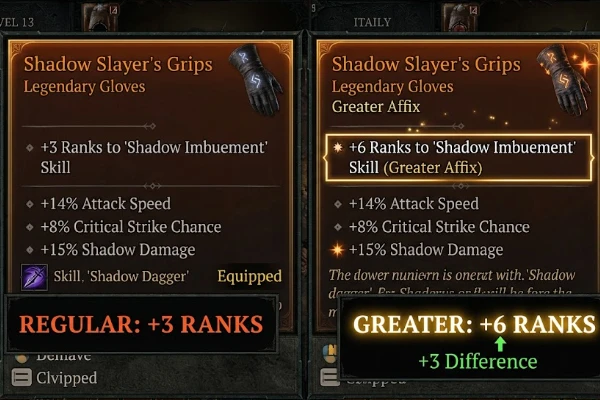
Greater affixes turned legendary evaluation upside down. A single greater affix on the right stat can be worth more than three regular affixes. A piece with two greater affixes that align with your build is better than an ancestral piece with all four stats correct but no GAs. The power gap is that large.
This creates a new problem: the gear treadmill got longer. Before GAs existed, finding a well-rolled ancestral with the right aspect was endgame. You were done with that slot. Now there is always a better version out there, because the odds of finding a piece with two or three GAs, all on the stats you want, with a max-rolled aspect, are astronomically low.
My practical advice is to treat one-GA items as your baseline for endgame gearing. Aim for the GA to land on your most important stat for that slot, whatever that is for your build. Two-GA items are upgrades you chase. Three-GA items are lottery wins that you build around. If a three-GA ancestral drops and one of the stats is wrong, you enchant the wrong one off and celebrate. Do not hold out for four perfect GAs. You will be waiting forever.
Keep, Salvage, or Extract
I developed a simple decision tree for every legendary that drops, and my stash has been clean ever since.
Ask the aspect question first. Is this aspect useful for your current build, or a build you are actively planning to switch to? If the answer is no, salvage the item immediately. The Blacksmith gives you materials and the aspect roll is saved to your Codex of Power permanently, no exceptions. There is no separate extraction step anymore, and that is the best quality-of-life change the game has made. You salvage, the Codex updates, you move on. If the aspect roll is not an upgrade over what your Codex already has, you still get the materials.
If the aspect is relevant, look at the item power and the affixes. Non-ancestral items with no greater affixes are almost never worth keeping past the early endgame. Once you are in Torment I or higher, you should only be looking at ancestral legendaries as potential permanent gear. Sacred legendaries exist to be salvaged. Their aspects go to the Codex, their materials go to the Blacksmith, and you move on.
For ancestral items with a useful aspect and at least one relevant greater affix, keep it. Enchant the worst affix if the other three are solid, but only do one or two rolls. If it does not hit, use the item as is and wait for a better base. Since salvaging automatically upgrades your Codex, any good aspect roll on a mediocre item is already banked, no extraction needed. If the aspect is perfect and the item base is trash, just salvage it. The perfect roll lives in your Codex forever now.
Salvage everything else. I know it feels wrong. The orange text tricks your brain into thinking the item is special. It is not. The Blacksmith needs those materials, and you need the stash space. A clean stash is worth more than fifty legendaries you will never equip.
Tempering Before You Commit
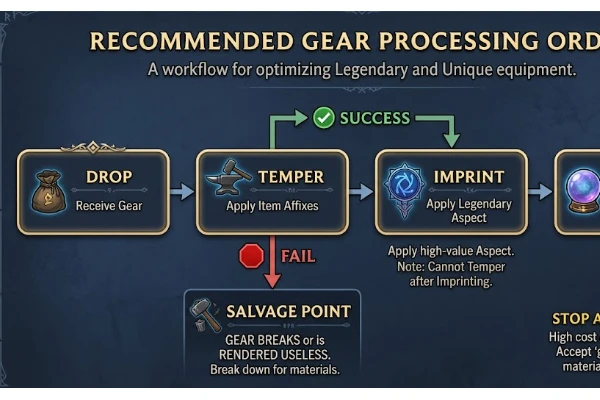
One mistake I made repeatedly was imprinting a legendary before tempering it. If you imprint first and then brick the temper, you have wasted a potentially valuable aspect. The item cannot be un-imprinted. So temper always comes first. If the temper whiffs and you run out of rerolls, salvage the item immediately. You lost nothing but materials.
The real question is what comes second: enchanting or imprinting. I used to say enchant next, because the logic was "do not imprint until the item is finished." I was wrong. Here is what I have learned since.
Imprinting from the Codex is cheap and has a fixed cost. It does not escalate. Enchanting at the Occultist, on the other hand, gets absurdly expensive after just a few rerolls. If you enchant first and sink five million gold into chasing a stat, then the item is still not usable until you imprint it. You have spent gold and have nothing equipped. If you imprint first instead, you can use the item immediately with its main aspect active. Then you do one or two enchant rolls on the bad affix. If it hits, great, you are done. If it does not, you still have a functional legendary with the right aspect and acceptable stats. You wear it while you look for a better base.
So the correct order is: temper first, imprint second, enchant last. Temper is the gatekeeper. Imprint locks in the build-defining power at a fixed low cost. Enchant is the optional optimization step that you walk away from after a couple of attempts. This sequence has saved me more gold and frustration than any other habit in my gearing process.
The Codex Changed How You Hunt for Aspects
The current version of the Codex of Power saves your strongest aspect roll permanently. When you salvage a legendary at the Blacksmith, the aspect roll is automatically saved to your Codex. No separate step, no gold cost, no inventory clutter. Just salvage and the Codex updates. This fundamentally changed the legendary economy.
Before this change, you had to keep backup copies of every important aspect in your stash. Three Edgemaster's aspects, two Disobedience aspects, four copies of every class-specific offensive aspect you might need. Stash management was a full-time job. Now you hunt each aspect once, salvage the best roll you can find, and it stays in your Codex forever for that character.
This means your legendary evaluation should shift toward aspect hunting early in a season. When you are still filling out your Codex, any aspect upgrade is worth salvaging to bank the roll, even from a sacred item. Once your Codex is mostly filled with good rolls, you can be much more selective. At that point, only ancestral items with greater affixes deserve your attention. The rest are materials.
The one thing the Codex did not solve is the imprinting cost. Each time you use the Codex to imprint an aspect, it costs the same materials and gold as using a physical aspect item. If you are constantly swapping aspects on the same piece of gear, those costs add up. Decide on your build before you start imprinting. Changing your mind halfway through is expensive.
Legendary gear in Diablo IV is a system that rewards patience and punishes impulse decisions. The players with the cleanest stashes and the strongest builds are not the ones who play the most hours. They are the ones who know when to say no to a shiny orange item that does not actually help them. Spend your gold on the right decisions, not on fixing the wrong ones.


