












English


Gameplay
Diablo 4 Soul Splinters: How to Farm Them




The jewelry in Season 15 does more than hold resistances now. Soul Splinters are the small gems that sit in your rings and amulet, and each one is tied to a specific resistance, which points you at a matching gem reserve. Once you learn that mapping, farming them stops being a random hunt and turns into a short checklist. Most of the time you spend "looking" for these things is really time you spend not knowing which reserve to run.
Match the Splinter to Its Gem Reserve
The rule that changes everything: seven of the eight splinters line up with a resistance, and that resistance tells you which Horadric Gem Reserve to hunt for. The reserve is an affix that rolls on Nightmare Dungeons, not a fixed location. When a dungeon carries the reserve you need, open its chests and the loot pool narrows toward the splinter you want.
- Splinter of Anguish matches Fire, so look for Ruby Reserves.
- Splinter of Sin matches Lightning, so look for Topaz Reserves.
- Splinter of Lies matches Cold, so look for Sapphire Reserves.
- Splinter of Pain matches Poison, so look for Emerald Reserves.
- Splinter of Damnation matches Shadow, so look for Amethyst Reserves.
- Splinter of Hellfire matches all elements, so look for Diamond Reserves.
- Splinter of the Mother matches Physical, so look for Skull Reserves.
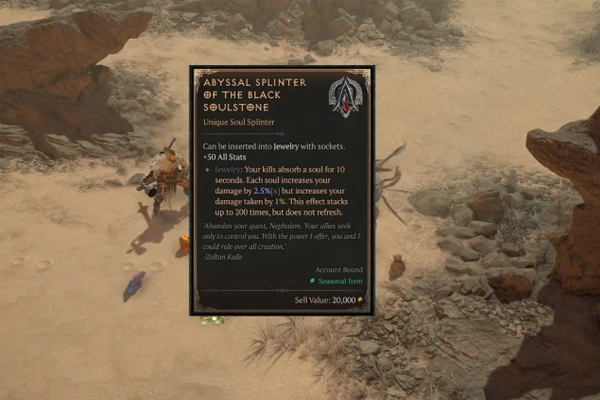
The eighth splinter, the Black Soulstone, grants All Stats instead of a resistance. That one has no matching reserve, which is why it is the hardest to chase and why plenty of players leave it until late in the season when their other pieces are already sorted.
The Rarity Ladder and the Horadric Cube
These gems drop at four rarities, and the naming is where people get lost. A Lesser splinter is Magic quality, a Splinter is Rare, a Greater is Legendary, and the top end is Abyssal, which is Unique. Most of what you collect in the first week is Lesser and Rare, and that is fine, because the Horadric Cube lets you combine them upward.
The Amalgamation recipe works the same at every step: feed five of one tier to make one of the next. Five Lesser combine into one Splinter, five Splinters combine into one Greater, and five Greaters combine into one Abyssal. Run that chain end to end and a single Unique costs you 125 Lesser splinters, assuming you feed only matching types. That sounds steep until you see how fast Rare drops stack up once you are actually running the right reserves.
The Ways to Farm Them
There are a handful of sources, and they are not all equal. The first two below cover most of what you need, with the rest acting as backups.
- Escalation is the mechanic to lean on. It chains three Nightmare Dungeons into one continuous run, and the Branching Pathways War Plan node adds extra portal choices between floors, which means more chances to roll the reserve affix you want.
- Once a dungeon rolls your matching reserve, open every Horadric chest on that floor. Chests drop the matching splinter at Magic or Rare quality, and bosses can push it up to Legendary.
- The Kurast Undercity has a slower but reliable path. The Bauble Day and Gutter Filth War Plan nodes can spawn a Portal Prankster who reveals a Cabochon Merchant that sells splinters for gold.
- Season reputation caches on the post-track rewards guarantee Rare splinters, so keep claiming them after the main track is done.
- Uber Prime Evils drop a guaranteed Unique splinter on your first kill. It is expensive in materials, but it skips the whole upgrade ladder.
Helltides drop splinters randomly and are not worth chasing on purpose. Treat those as passive income while you are there for something else.
None of these sources guarantee a specific splinter on demand, and that is worth accepting early. What the good methods do is collapse a wide random pool into a short one, which turns a lottery into a grind you can schedule around.
An Abyssal Splinter Is Not Always the Goal
The rarity ladder also warps how people spend their time. An Abyssal splinter sounds like the obvious target, but a Legendary splinter of the resistance you actually need will usually beat a Unique splinter of the wrong one. I see players burn a full week chasing 125 matching Lessers for one Abyssal while a Greater splinter of the right type sits unsocketed in their bag doing nothing. Socket the best matching splinter you have right now, then upgrade around it. The gear gap between a good Greater and a bad Abyssal is a lot smaller than the time gap between them.
The reserve system also explains a mistake I made early on. I assumed a matching reserve guaranteed the splinter, so I ran a Ruby Reserve expecting Anguish and came out with a couple of Amethyst-flavored drops instead. The reserve narrows the odds, it does not remove them. That is why committing to a splinter you can use today beats holding out for one you might want next week.
Is the Grind Worth It
Where this system really pays off is endgame resistance pressure. Once you push into the higher Torment tiers, the difference between capped and near-capped resistances shows up fast, and splinters are one of the few places you can tune a single resistance without touching your main gear. That flexibility is what keeps me coming back to the reserve loop even after my main build is finished.
The short version: learn the resistance-to-reserve map, run Escalation dungeons with Branching Pathways, and socket the best match you have instead of waiting for perfect. It is a grind that respects your time once you stop treating it like a lottery.


