











English


Gameplay
Tarisland Mage DPS Guide: Rotation, Talents, and Advanced Techniques




Since the launch of Tarisland, the Mage has remained one of the most competitive and sought-after DPS classes for raiding and high-tier progression. It boasts a high damage ceiling, spectacular spell effects, and a secure spot in any serious raid group. However, Mages operate on a completely different axis compared to melee DPS. Your damage output isn't just about standing still and pressing buttons in a fixed order. A Mage's true ceiling comes down to two things: the fluidity of your rotation rhythm and how little damage you lose while forced to move.
I’ve seen plenty of Mages with solid gear and a copied talent tree whose real combat output parses well below others at the same item level. The issue is rarely their equipment; it’s their rhythm and their lack of understanding regarding how talents interact. What follows isn't a mindless data dump—it’s a framework for how you should actually think when playing a Mage in Tarisland.
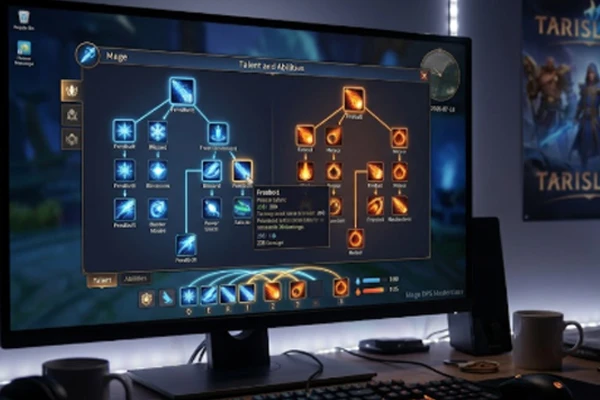
Frost vs. Fire: Two Completely Different Damage Models
Tarisland provides Mages with two core specializations, each featuring entirely distinct damage profiles:
-
Frost Specialization (Sustained Damage Model): This is your classic consistent output curve. Frost Mages utilize baseline skills (such as Ice Bomb) to rapidly generate "Ice Crystals/Water Energy," then spend them on instant-cast abilities like Ice Cone. Frost damage is smooth and relentless, lacking a punishing downtime but heavily demanding that you maintain a flawless cast rhythm over long encounters.
-
Fire Specialization (Burst Window Model): This is a strict window-based burst profile. Everything revolves around building "Heat," mastering the detonation timing of your Thermal Bomb, and perfectly aligning your cooldowns during brief damage-amplification phases. Fire Mages can spike to the top of the meters instantly, but they must spend the windows between bursts executing basic filler rotations to pool resources again.
The specialization you choose dictates your secondary stat priorities, your rotation structure, and when you should commit your major skills during a boss encounter. Frost excels in long, heavy-movement raid bosses with massive health pools where you must keep damage flowing on the move. Fire shines in fast-paced, high-density scenarios like Arcane Realms (Dungeons), where trash packs come in waves and you can consistently wipe them out with a massive burst pull.
Mixing up these mindsets is the root cause of poor performance—playing Fire like Frost by blindly hitting your big skills the second they come off cooldown without resource pooling or buff alignment will completely tank your DPS.
Rotation Training: Build Conditioned Reflexes, Not Muscle Memory
A Mage's rotation doesn't follow a fixed attack-speed rhythm like a melee class. When multiple skills are available simultaneously, the order in which you press them swings your total damage significantly. I strongly advise against memorizing a rigid keypress sequence from target dummy guides. In real combat—with boss movement, targeted mechanics, and phase transitions—you will never replicate a target dummy environment. Instead, you must master these core decision-making principles:
-
Align Cooldowns and Damage Buffs Whenever Possible: Do not press a short-cooldown damage ability the instant it lights up. If waiting an extra 3 to 5 seconds allows you to align it with an upcoming major cooldown or a team-wide damage multiplier, the burst payoff from holding that skill will far outweigh the minor uptime you sacrificed.
-
Manage Resources: Never Cap, Never Bottom Out: Tarisland Mages do not have auto-attacks and do not rely on standard mana management. Running completely dry means you are reduced to doing minimal damage with baseline filler spells, while capping your resources means wasting subsequent generation. Keep your resource bar hovering in the upper-middle threshold—spend consistently, but always maintain a tactical reserve.
-
Plan Your Movement Around Instant Casts: When a boss drops a ground effect that forces you to reposition, check your instant-cast availability first (such as a Frost proc or a Fire instant-trigger skill). Save those instant spells to cast while you are physically running, and hold your hard-casted channeled spells for when you are firmly planted.
-
Evaluate AOE Spacing and Skill Shapes: AOE skills in Tarisland have distinct geometric boundaries (cones, circles, straight lines). If three targets line up, use your linear clear; if five or six enemies clump together, commit your circular drop. Reading the pack's positioning before casting yields far more damage per cast than blindly firing AOE abilities the second they come off cooldown.
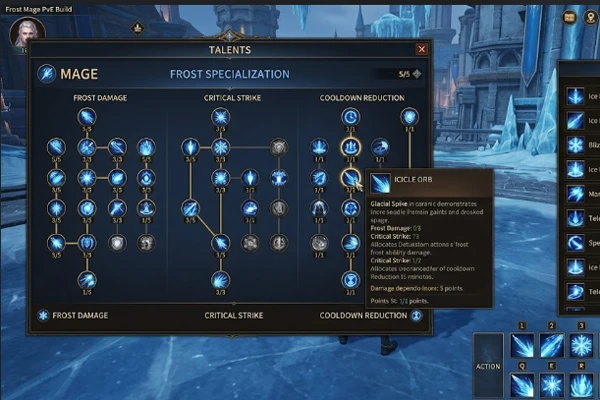
The Core Logic Behind Adaptive Talent Choices
Most players look up a build guide, take a screenshot, and copy the talent nodes exactly. While this secures a decent baseline, completely outsourcing your talent logic means you forfeit the ability to push your personal ceiling. Mage talent customization boils down to balancing three major trade-offs:
-
Single-Target vs. AOE: Raid bosses lean heavily toward single-target optimization, while Arcane Realm dungeons demand aggressive AOE clear. You must tweak your nodes based on the content at hand—bringing a pure single-target boss build into a dungeon run will severely drag down your group's clear speed.
-
Burst vs. Sustained Uptime: Burst-oriented talents concentrate massive damage into tight windows—ideal for bosses with vulnerability phases or priority adds that must die instantly. Sustained talents favor uninterrupted uptime over a long duration. Pay attention to your group composition as well; if your party already features two heavy burst-DPS classes, switching to a sustained build to smooth out the team's damage during their cooldown valleys is often the optimal play.
-
Utility vs. Raw Damage: Some talent nodes do not directly increase your DPS numbers on paper, but they offer damage reduction, tactical mobility, or team utility. During the Progression Phase, fixed raid teams will frequently expect their Mages to sacrifice a fraction of personal DPS to run mechanics or assist with raid survival. Once content is on Farm Phase and the execution is flawless, you can fully spec back into greedy, pure-damage talent trees.
A great Mage spends three minutes adjusting their talent nodes right before entering a dungeon or raid instance. Those three minutes of tailored optimization will often net you a larger DPS gain than spending millions of gold trying to force out a gear upgrade.
How Stats and Gear Synthesize with Your Talents
A Mage's stat priority is entirely dependent on your active talent choice, not a rigid mathematical formula. The weights of your four core secondary stats—Crit, Haste, Mastery, and Combo—shift dramatically based on your specialization:
-
Fire (Burst Spec): Heavily prioritizes Crit and Mastery. Because your damage is concentrated into tight burst windows, ensuring that every single high-value spell critically strikes is the key to achieving exponential damage spikes.
-
Frost (Sustained Spec): Lean heavily into Haste and Combo. Your damage relies on sheer spell volume over time; casting faster and triggering more combos directly translates to a massive, steady climb in overall damage output.
When gearing up, your best approach is to use crafted gear to specify secondary stats on your core slots (prioritizing your weapon and trinkets) to guarantee your baseline stat alignment is correct. Use your weekly Arcane Realm vault rewards and random raid drops to gradually fill in the remaining slots for raw item level. Never do it the other way around—equipping random, high-item-level raid gear with completely mismatched stats (like a Frost Mage wearing full Crit/Mastery gear) will create an unoptimized stat profile that actively hinders your DPS.
The Most Underrated Skill: Achieving "No-Loss" Mobility
After breaking down rotations and talents, we must address the ultimate skill gap that standard guides rarely touch upon: Your actual damage ceiling is determined by how little damage you lose when forced to move.
Encounter designs in Tarisland are littered with ground hazards, targeted lines, and phase transitions that force casters to move much more frequently than melee classes. Melee players can continue their full rotation while strafing; Mages running without an instant-cast ready drop to zero DPS. Across a five-minute encounter, spending a cumulative 20% of the fight running aimlessly means your output automatically takes a 20% penalty.
To reclaim that lost 20% of your damage, embed these three habits into your core gameplay:
-
Never Gamble on Casts (Do Not "Blink-Cast"): In Tarisland, activating your mobility tool (Blink) will instantly and forcefully cancel any hard-channeled spell currently in progress. Do not attempt to slide-cast or finish a greedy cast if a lethal mechanic is incoming. It is always mathematically better to clip your own cast, move a step to safety, and resume, rather than taking a hit or having your cast forcibly interrupted by a mechanic's crowd control.
-
Reposition by Inches, Not Miles: When a ground hazard appears, do not panic-run across the entire platform. Walk or slide just far enough to clear the visual edge of the indicator box, stop immediately, turn, and resume your cast. Minimizing your travel distance is the easiest way to save your global cooldowns.
-
Pre-Pool Instants Ahead of Mechanics: Memorize the encounter's timeline. If you know a major movement phase or a ground-shattering mechanic is occurring in 5 seconds, actively hold onto your instant-cast procs or resources. When the boss forces you to run, you can seamlessly dump those instant spells on the move, maintaining your output while executing the mechanic flawlessly.
Once you convert these movement habits into pure muscle memory, your DPS will skyrocket—not because of a lucky drop in your character screen, but because of a massive upgrade in your mechanical awareness and execution.


