











English


Guide
POE2 Passive Skill Tree Guide




The first time most people open POE2's passive tree, nine out of ten of them freeze. A screen absolutely packed with nodes, like a spiderweb someone spilled ink all over, and no clue which direction to go. Pick a few that look decent, head out, and by Act 3 the damage is a wet noodle, survivability is crumbling, and respeccing feels too expensive, so that character just rots. Spend an afternoon actually studying how the tree works, though, and it turns out there are only a handful of rules that govern the whole thing. Once those rules click, the tree goes from "no idea where to start" to "I know exactly which parts have nothing to do with me."
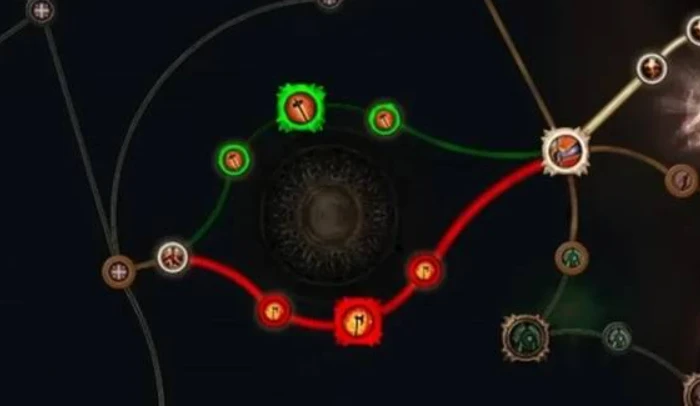
There are only a few types of nodes on the tree — learn them and you'll never feel lost
POE2's passive tree is shared by all classes on a single giant map, but each class starts in a different spot — Warrior in the southwest, Ranger in the southeast, Witch and Sorceress straight up north. The tree looks chaotic, but there are really only a few categories of nodes. Learn to tell them apart, and the whole picture becomes readable.
- The small nodes along the paths are attribute nodes and basic stat boosts. Attribute nodes grant Strength, Dexterity, or Intelligence — you choose which one when you allocate them — and you can swap the attribute type later for gold. The basic boost nodes are the ones that say things like "8% increased damage" or "5% increased armour." Individually they're unimpressive, but they're the toll roads leading to stronger nodes, so treat them as the price of admission.
- The only nodes worth going out of your way for are Notables and Keystones. A Notable is the biggest icon in a cluster, and its effect is dramatically stronger than the small nodes around it — things like "25% increased damage with one-handed melee weapons" or "fire damage penetrates 10% resistance." A build path is, at its core, just drawing a line from one Notable to the next. Keystones are double-edged swords — "you cannot deal non-critical damage, but your critical strike chance is doubled," that kind of thing. Big upside, big downside. Read the downside carefully before clicking. The most common newbie mistake is seeing the shiny half of a Keystone, clicking it immediately, and then wondering ten maps later why everything suddenly kills you so fast.
The most misunderstood thing about this tree is the idea that you need to understand the whole thing. You don't. You only need to understand the third of it closest to your starting point. A Warrior does not need to know what the spell nodes in the top-right look like. A Witch has no reason to care about the armour clusters in the bottom-left. New players should just figure out the two or three major clusters near their starting area and call it enough. The rest of the tree isn't relevant to the current build yet. Learn it later, when the build changes.
Don't overthink Weapon Specialization — new players don't need a second setup at all
Weapon Specialization is the most unique mechanic on POE2's passive tree. The game awards a separate pool of Weapon Set points — up to 24 total — earned through optional bosses and side quests across the campaign. These points can be allocated differently between Weapon Set I and Weapon Set II, and the tree reconfigures automatically when you swap weapons. Sounds flexible, and it is. But for a new player, the smartest move with this system is to not overcomplicate it.
Weapon Set points and regular passive points are two completely separate systems. Weapon Set points cannot be converted into regular passive points to boost your permanent tree. Their entire purpose is to let you take different paths for different weapons — ranged damage nodes when you swap to a crossbow, block and defense nodes when you swap to a shield. But here's the thing: most new players use one weapon from start to finish and never weapon-swap during combat at all. If that's you, just allocate all your Weapon Set points to your main weapon's side and leave Set II alone. Those points will be active whenever your primary weapon is equipped, which is always.
Should you split some points out to Set II? The answer is simple: only when you actually start swapping weapons mid-combat on a regular basis. Until then, keep everything in Set I and let your current setup get the full benefit. Don't burn mental energy trying to craft a second configuration you'll never actually switch to. This system gets more useful the later you engage with it — not the earlier.
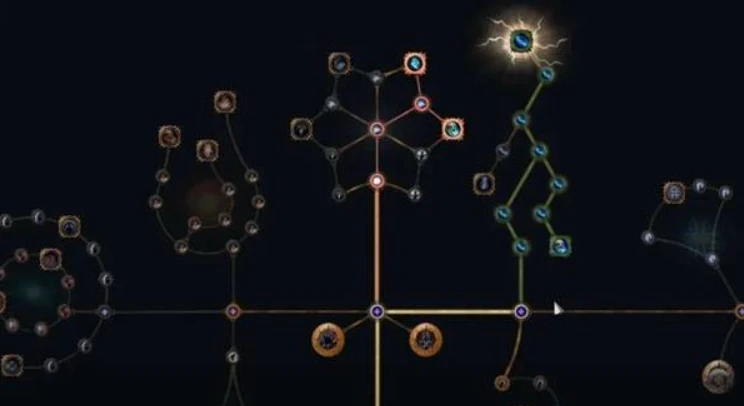
Three mistakes almost every new player makes on the passive tree — make one and you've wasted half a day
POE2's passive tree has no single correct answer, but it absolutely has some guaranteed wrong ones. The following three pitfalls have claimed almost every new player — some discovered only after bricking a character, some clawed back through painful gold respecs.
- Don't spread points across multiple damage types. If the main skill deals fire damage, every point goes toward fire. If it's physical melee, stop looking at the cold nodes. A lot of new players think "a little bit of everything will pay off later." What actually happens is the damage gets diluted to the point where nothing dies efficiently. The search bar at the top of the passive tree is the best tool available — type in a skill keyword and every relevant node lights up. Following the glow is ten times faster than wandering around by feel.
- Don't plan a build around the maximum 123 points. You won't hit max level until well past level 99, and most builds should be fully functional at 90 to 100 points. If the planned path can't even reach the first major Notable by 80 points, there's too much detour. Lock in the core two or three clusters first, then fill in the peripheral nodes gradually as levels come in later.
- Don't overlook resistance nodes. POE2's tree has far fewer life nodes than the first game, but that doesn't mean gear is the only way to build survivability — elemental resistances are the most cost-effective defensive investment in the game. Aim to cap fire, cold, and lightning resistances at 75% before Act 3. Resistance clusters on the tree combined with resistance rolls on gear are the fastest route there. Plenty of players die to campaign bosses not because their damage was too low, but because uncapped resistances got them one-shot by a big ability.
The most anxiety-inducing thing about POE2's passive tree is the feeling that one wrong click ruins everything. The reality is: respeccing only costs gold, and gold is everywhere. Once the Atlas is open, a few maps will net tens or even hundreds of thousands — respeccing dozens of nodes is trivial. The best thing a new player can do isn't calculating every step to perfection. It's picking a direction, pushing forward, and respeccing when something feels off. The tree is far more forgiving than it looks. It's a tool, not an exam. The sooner the fear of clicking is gone, the sooner the game actually starts making sense.


