












English


News
Master POE2 Currency Exchange: Essential Guide & Gold Tips




If you are coming to Path of Exile 2 from almost any other modern ARPG, the trading system will feel like stepping into a different era. There is no auction house where you click a button and currency appears in your mailbox. There is no universal gold standard that smooths every transaction into a simple exchange.
Instead, PoE 2 inherits and refines the trading philosophy of its predecessor: player-driven barter, asynchronous currency markets, and a firm separation between the gold you earn and the currency you trade.
This guide walks through everything currently known about trading in Path of Exile 2, based on developer communications and the systems carried forward from PoE 1. Because the game is still in early access, some details remain speculative—but the core mechanics are established enough to plan around.
The Gold Exception
Let us start with what you cannot trade, because it is the most common point of confusion for new players.
Gold is soulbound.
You earn gold by killing monsters. You spend gold on:
-
Purchasing items from NPC vendors
-
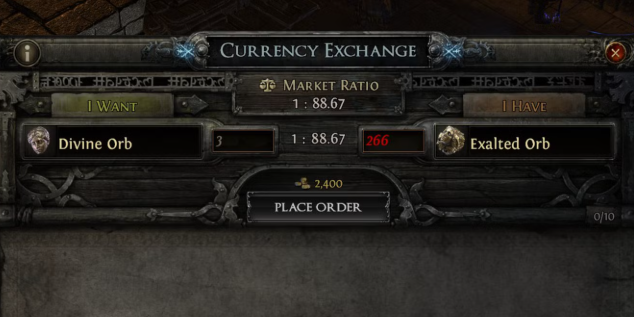
Listing currencies on the exchange
-
Respeccing your passive skill tree
-
Paying certain endgame fees
What you cannot do is trade gold to another player. It does not appear in the trade window. It cannot be listed on the currency exchange. It exists purely as a personal resource, earned and spent by each character independently.
This design choice is deliberate. By removing gold from the player economy, Grinding Gear Games ensures that the true trading currency remains the consumable items that drop from monsters—the orbs, essences, and fragments that actually affect gameplay. Gold handles the friction costs of the economy without becoming the economy itself.
The Currency Exchange – Asynchronous Trading for Stackables
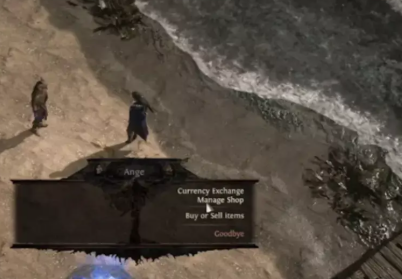
One of the most significant quality-of-life improvements carried forward from PoE 1 is the currency exchange market. This is not a traditional auction house. It is an asynchronous order-matching system designed specifically for stackable items.
What you can list on the exchange:
-
Basic currencies (Chaos Orbs, Exalted Orbs, Divine Orbs)
-
Runes and Soul Cores
-
Essences
-
Omens and Catalysts (endgame crafting currencies)
-
Unprocessed Waystones and Tablets
What you cannot list on the exchange:
-
Any equipment (including legendary items)
-
Crafted or processed Waystones/Tablets
-
Rare items
-
Jewels
-
Any non-stackable item
How it works:
You open the currency exchange interface and select two currencies: the one you want to receive (left side) and the one you are offering (right side). The system displays current market ratios for reference.
You set your desired exchange rate. For example, you might offer 10 Chaos Orbs and request 1 Exalted Orb. You then place the order and pay a gold fee proportional to the transaction size.
Your order enters a queue. When another player places a matching order on the opposite side of the trade, the system executes automatically. Currency is transferred, and both players receive their items without ever needing to meet in-game.
If no match exists immediately, your order remains active until fulfilled. You can check back later or cancel the order and reclaim your currency.
This system eliminates the need for manual negotiation on basic currency flips. It is fast, transparent, and significantly safer than player-to-player trading for stackable items.
Player-to-Player Trading – The Only Way to Trade Gear
For everything that cannot be listed on the currency exchange—which is to say, almost all equipment—you must use the traditional direct trade system.
The process:
-
You find a buyer (or seller) through the official trade website or in-game chat.
-
You invite the player to your party.
-
One of you travels to the other's hideout.
-
You open the trade window and present your items.
-
Both players verify the contents carefully.
-
Both click Accept, and the trade completes.
Critical differences from other games:
-
No gold involved. You are trading items for items, or items for currency. The currency itself is an item (Chaos Orbs, etc.).
-
No remote delivery. You must be in the same instance to complete the trade.
-
No buyer protection beyond your own verification. Once you click Accept, the transaction is final.
This system places the burden of verification entirely on you. Check every item. Confirm quantities. If something feels wrong, decline and walk away.
The Trade Website – Finding What You Need
Path of Exile 2 uses the official trade website, maintained by Grinding Gear Games, as the primary discovery layer for player listings. This is where you search for items, compare prices, and initiate contact with sellers.
Search capabilities:
-
Filter by base type
-
Filter by affixes and affix tiers
-
Filter by item level and quality
-
Filter by explicit and implicit modifiers
-
Filter by corruption status
-
And dozens of other parameters
When you find an item you want, the website generates a pre-written whisper message. You copy it, paste it into in-game chat, and send it to the seller. If they are available and willing to sell at the listed price, they will invite you to their party.
Listing your own items:
To sell items, you place them in a public stash tab and set a price. The trade website indexes these listings automatically. You do not need to create separate forum posts or manually update listings. As long as the item remains in the priced tab, it is visible to the entire player base.
You can continue mapping or doing other content while waiting for buyers. When someone whispers you, you can choose to respond immediately or finish what you are doing first.
What Will Be the Default Currency?
PoE 1 settled on a de facto currency system: Chaos Orbs for small to medium transactions, Exalted Orbs for larger ones, and Divine Orbs for the highest-end gear. This emerged organically from player behavior, not from any game rule.
PoE 2 will likely follow a similar pattern, but the specific currencies may shift based on drop rates and crafting utility.
Early access indicators suggest:
-
Chaos Orbs remain the most liquid mid-tier currency. They drop frequently enough to be accessible but remain valuable enough to serve as a medium of exchange.
-
Exalted Orbs will probably retain their role as high-tier currency, though their exact value relative to Chaos will depend on slamming demand.
-
Divine Orbs may become more prominent if crafting meta shifts toward perfect rolls.
New currencies introduced in PoE 2—such as the various tablets and soul cores—may also emerge as regional trading standards within specific communities. For general-purpose buying and selling, however, Chaos and Exalts are the safest bets.
Practical Trading Tips
For buyers:
-
Verify the item stats against the trade website listing before completing the trade.
-
Be prepared to tip slightly above list price if the seller is doing you a favor (e.g., leaving a map to trade).
-
Respond promptly to party invites. Sellers have limited patience for AFK buyers.
For sellers:
-
Price your items realistically. Check current listings for similar items before setting your price.
-
Keep your public tabs organized. Overpricing everything leads to no sales; underpricing everything leads to regret.
-
Respond to whispers when possible. Even a simple "one moment" maintains goodwill.
For currency exchange users:
-
Check the current market ratios before placing large orders. The system displays recent trades for reference.
-
Be patient with slow-moving currency pairs. Some exchanges take hours or days to fill.
-
Remember the gold fee. Keep enough gold on hand to list your orders.
The Bottom Line
Path of Exile 2's trading system rewards understanding and punishes assumptions. The distinction between gold (personal, untradeable) and currency (tradable items) is fundamental. The separation between the automated currency exchange and manual player trading defines how you acquire different types of items.
If you are new to this system, start small. Trade a few Chaos for Exalts on the exchange to learn the interface. Buy a single piece of gear through the trade website to understand the whisper-and-invite flow. Sell one item from your public tab to see how listings propagate.
The economy in PoE 2 is not a background system. It is a core gameplay loop that connects every piece of content. Master it, and you will never be stuck staring at a gear wall again.
We maintain current currency ratio data and seller verification for Path of Exile 2.


