












English


Guide
Fallout 76 How to Build a French Farm CAMP?




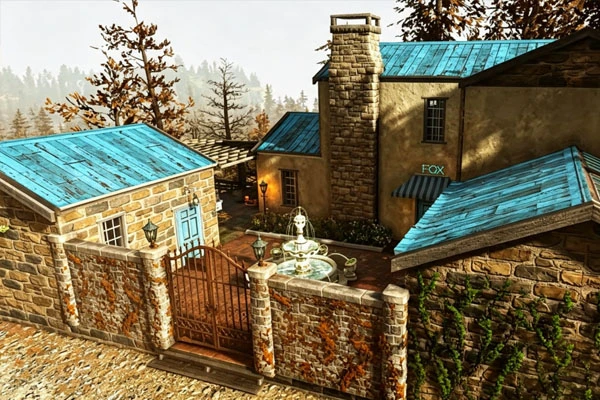
The French farm is a thematic style in Fallout 76 CAMP building that blends pastoral atmosphere with the wasteland environment. Unlike combat-oriented camps that emphasize defense and utility, the core of a French farm lies in spatial layout and material pairing—using white walls to simulate stucco texture, dark wooden beams to echo half-timbered construction, and courtyards with crop areas to create an agricultural corner seemingly forgotten by the war. This style does not rely on rare building materials, but it does require attention to site selection, building orientation, and decoration density.
Finding a Spot That Looks Like the French Countryside
Site selection for a French farm does not require perfectly flat ground, but three conditions must be met simultaneously: an open view, proximity to a water source, and no overly intrusive industrial structures in the background. The Forest region is the top choice. The grass here is greener and brighter, and against the scorched yellow ground of the Ash Heap, it does a far better job of setting off the clean look of white exterior walls. The riverside area north of Flatwoods features large stretches of gently sloping grassland, and looking out from the front entrance of the camp, the natural light reflecting off the river is visible. The area north of Summersville near the river offers more varied terrain, suitable for placing the main building on high ground with farmland distributed across the slopes below.
The area around the Sunshine Meadows Industrial Farm is also an underrated choice. This location already has large fields of tatos and razorgrain. Placing a camp right next to the existing farmland saves a significant amount of the CAMP budget that would otherwise go toward dirt tiles and crop planting. The downside is the occasional low-level Scorched spawn, which calls for one or two turrets placed around the courtyard perimeter as a symbolic defense.
What Building Materials Create a French Look
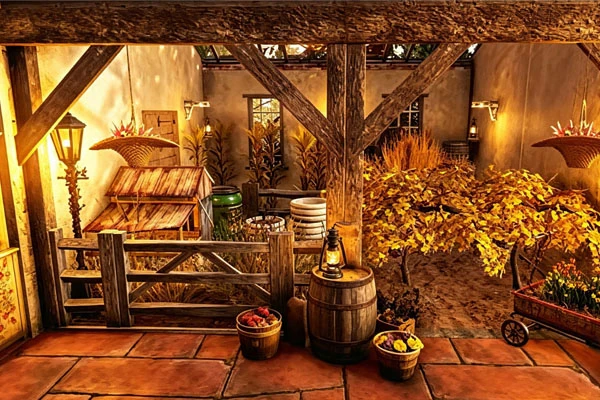
The visual identity of a French farm comes primarily from two elements: white or light-colored exterior walls, and dark wood roofing and beam decorations. Among Fallout 76's available building sets, the following combination comes closest to this effect:
- Contemporary Set white walls as the main exterior. This set's white has a grayish-white cast that, under daytime lighting, approximates the texture of limewash, and at night takes on a warmer yellow tone under soft lighting.
- Barn Set wooden roof and balcony railings. Dark brown wood covering the top of white walls creates the most classic color contrast found in French half-timbered architecture.
- Greenhouse Kit glass walls and glass roof for a courtyard or standalone garden area. A glass greenhouse standing independently beside the main building, filled inside with dirt tiles and crops, is the single structure that most strongly conveys the French farm theme.
- Farmable Dirt Tiles obtained through Gold Bullion exchange. Placed inside the greenhouse or on rooftop platforms, they protect crops from ground-level monster damage and also allow a complete separation between planted and non-planted areas within the courtyard.
Space Allocation for the Courtyard and Crops
The spatial layout of a French farm places the main building at the front, farmland at the rear, and the courtyard to the side. The main building faces south, with the front entrance looking out over the open landscape. On the right or left side of the building, carve out a courtyard area enclosed by wooden fencing. Inside, place iron tables and chairs, a water well, and several sets of potted plants. The farmland area goes behind the building, using dirt tiles to lay out a regular planting strip. Each row should span three to four tiles, with enough space left between rows to walk and harvest.
Crop selection should take visual consistency into account. The purple leaves of mutfruit are too visually prominent against a green backdrop and are better planted alone in a corner rather than as part of the main crop area. Razorgrain, with its yellow stalks catching the light filtering through the trees, offers the closest visual match to a wheat field and works well as a large-area filler crop. Corn and carrots can be alternated along the edge of the courtyard as a decorative vegetable garden that serves no actual production function.
How to Decorate the Building
The atmosphere of a French farm is not carried by the building structure alone—it is built up through decoration density. Several key decoration points: place one iron wall lamp on each side of the main entrance. The warm light source at night reinforces the cozy feel of the white walls. Hang a wind chime or a bundle of dried flowers from the beam above the porch. On the iron round table in the center of the courtyard, place an oil lamp and a few wine glasses. This arrangement creates a sense of dissonance within the wasteland—the feeling that someone lives here normally.
The ground floor of the interior should be set up as an open kitchen and dining area. Place an old-style oven and wooden storage shelves in the kitchen corner, and arrange plates, cups, and food models on the dining table. The second floor needs only a bed and a wardrobe to keep the space airy. Decorate as much as possible— do not be afraid to pile small items onto tabletops. The charm of a French farm lies in its fullness, not in spacious neatness.
Building a French farm CAMP does not require large quantities of rare materials or Atom Shop exclusive items. The four core materials—Contemporary white walls, Barn wood roofs, Greenhouse glass, and Farmable Dirt Tiles—come from basic in-game acquisition channels. Everything else relies on decoration density and spatial layout to build the atmosphere. Choose a waterside slope in the Forest region, face the main building south toward the view, place the courtyard to the side, and the farmland at the rear. Once the spatial allocation and material pairings are locked in, the rest is just piling things onto tabletops.


