











العربية


Guide
Why You Should Start Getting Endgame Gear Early in AION 2




In AION 2, crafting isn't something you put off until you hit max level. Once you reach the endgame, Kinah, crafting materials, and your profession levels all directly shape how efficiently you can craft gear. If you wait until you need endgame gear to start raising your professions, you'll often have to catch up on profession levels, materials, and funds all at once, which puts real strain on your resources. That's why it's worth laying your crafting foundation early in Season 1. Don't toss the low-tier materials and finished items you pick up while leveling, and hold on to the Kinah you accumulate day to day. As your profession levels climb, you'll spend less time on preparation when it comes time to craft high-tier gear. Keep in mind that Season 1 doesn't require you to burn resources just to push crafting levels. Raising your professions at a steady pace, saving important materials, and choosing crafting projects around what your character needs will set you up for the endgame ahead.

Choosing the Right Crafting Professions
AION 2 currently has five crafting professions: Blacksmithing; Armorsmithing; Handcrafting; Alchemy; Cooking.
Pick your professions based on what your character's gear calls for. Most characters don't need to raise all five—two is usually enough. Blacksmithing carries the most weight, because every class ends up needing a Guard off-hand piece in its endgame setup, which gives it broad and steady demand. If your character leans heavily on consumables, consider Alchemy first—it's one of the professions that can produce flight-restoration items, which stay in constant demand in content like Abyss PvP. When choosing professions, don't just chase the number of professions; what matters more is keeping your profession levels aligned with the gear your character needs.
How to Raise Your Crafting Level
Raising your crafting level is a matter of working up from low-tier recipes. Start with level 1 recipes and keep going until you hit level 50. Once you reach 50, a follow-up quick quest lets you keep pushing your crafting level higher. The low-tier items and materials you produce along the way still have value—some of them feed into later recipes, so don't sell or discard everything before you've confirmed what it's used for.
Plan your crafting resources in this order:
Weapon → Guard → Necklace → Earrings
The weapon usually holds the most gear value, so it's worth putting resources there first. Guard, as an important off-hand slot for endgame builds, also needs to be prepared early. Necklaces and earrings are accessories—they take fewer materials to craft, so even when the result isn't what you wanted, the loss is usually easier to absorb, which is why they can wait until after your weapon and Guard. If your Kinah and material reserves are tight, raise your profession levels first rather than rushing to craft endgame gear in bulk.
Choosing Between 25% and 100% Success Rate
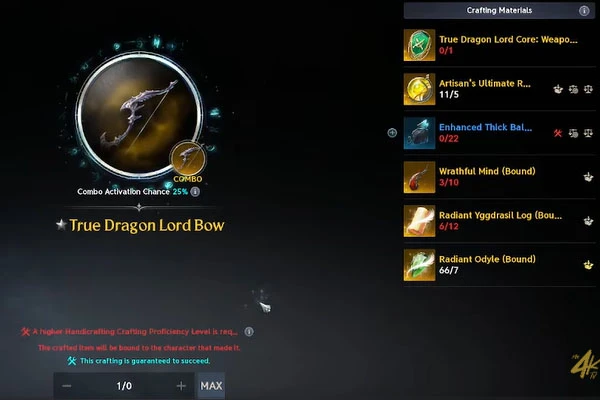
Once you get into endgame crafting, some gear presents you with recipes at different success rates. The usual choice is between a 25% success-rate recipe and a 100% success-rate recipe. The 25% recipe takes fewer materials, but the result carries a chance of failure. The 100% recipe costs more materials, but the craft is guaranteed to succeed.
The two options break down like this:
25% success rate: lower material cost, but the craft can fail.
100% success rate: higher material cost, but the outcome is guaranteed.
Which recipe to choose depends on how important the piece is and what your current resource reserves look like. For essential endgame gear, where a failure would throw off your whole setup, the 100% recipe is usually the safer call. For pieces that matter less, or when your materials are plentiful, or when you can afford to fail, the 25% recipe is a reasonable option. So the success-rate choice isn't simply a matter of higher versus lower—it's a trade-off between the materials you spend and how certain you want the outcome to be.
Magical Breath and Core
Endgame crafting also demands close attention to your Core. Different crafting projects call for different Cores, and picking the wrong one can mean burning materials on an item you didn't intend to make. One important resource, Magical Breath, comes from the season interface: Season → Season Shop → Materials → Magical Breath. There are currently only 5 Magical Breath per server, so confirm your final crafting target before using one. Given how scarce they are, don't spend one without first confirming your recipe.
You can source crafting materials mainly from: Season Shop; Gathering; Crafting merchants; Market (auction house); Dungeons; Shugo Festival.
Shugo Festival is a good place to stock up on crafting materials. If the event offers relevant rewards, collect them early according to what you need to craft. Gathering is also an important way to build up materials over the long run. You can gather on your other characters and send the materials you need to your main crafter, which saves your main the time spent running off to gather between leveling, PvE, or PvP. You don't need to gather every resource in one go—building up materials gradually, in step with your profession levels and gear needs, usually makes it easier to keep your Kinah and material costs under control.
Succession Crafting Is Not a Success Rate
Alongside normal crafting, AION 2 also has Succession crafting. Succession is mainly about moving state from an old piece of gear to a new one, and it's not the same thing as a recipe's success rate. Advanced Succession can even raise a Unique piece up to Heroic while preserving the state you've built up on it.
These two concepts are worth keeping separate: the crafting success rate determines whether a given recipe succeeds, while Succession moves the state you've already invested from one piece of gear to another. They serve different purposes, so don't confuse the 25% or 100% success rate with Succession crafting.
Items like Transfer Stone come from the relevant conversion recipes and from Substance Morphing. When you're due for a gear upgrade, check the Succession materials you'll need ahead of time so you don't finish a craft only to find you're missing a required item.
Why Craft Endgame Gear
The real value of crafted gear is that some endgame pieces carry PvE bonuses and extra stats. These stats aren't something ordinary dropped gear can fully replace, which is why crafting gradually becomes a major part of any endgame PvE setup.
The main pieces to work toward are: Weapon, Guard, Necklace, and Earrings.
The weapon and Guard usually take priority. Once those slots are done, fill in accessories according to what your character needs. If you'd rather not craft a weapon right away, the Ludra Heroic weapon works as a transitional option, letting you save your limited materials and Kinah for other important pieces. Pay close attention to your Core throughout the process. Some crafting projects require a specific Core or specific parts, which may come from dungeon drops or the market (auction house). Confirm the recipe before you commit so you don't waste materials. If you've already picked the wrong Core, try Substance Morphing—under the right conditions, you may be able to recover the resources.
Planning Crafting Resources in Season 1
Season 1 is better spent building a crafting foundation than dumping huge amounts of resources into every endgame piece at once.
A sensible sequence looks like this:
- Pin down the two main professions your character needs.
- Start raising profession levels from low-tier recipes.
- Hold on to important materials as you level.
- Set your crafting order for weapon, Guard, and accessories around what your gear calls for.
- Confirm your final target and the right Core before using Magical Breath.
- Only prepare Transfer Stone and Succession materials when a high-tier gear upgrade is due.
Free-to-play players and subscribers gather materials at different speeds, so planning matters even more. When resources are limited, you don't need to push every profession at once, and you shouldn't burn through large amounts of Kinah and rare materials just to chase crafting levels. In Season 1, focus on your profession levels, crafting materials, and Kinah reserves. Once your profession levels are in place early, you won't have to start from scratch when the time comes to craft endgame gear.
Crafting is a long-term resource-planning exercise. Endgame pieces like weapons, Guard, and accessories all have clear crafting requirements. Raising your profession levels ahead of time and keeping the right materials on hand reduces the resource strain when you finally craft. Confirm things like Magical Breath, Core, Substance Morphing, and Succession before you start. There's no need to rush the pace—investing resources step by step, in line with what your gear needs, fits Season 1's long-term approach better.


