












English


Gameplay
Path of Exile 2 Item: The Ultimate Beginner’s Guide to Understanding PoE 2 Loot




What Is a Path of Exile 2 Item? Let’s Start Simple
In Path of Exile 2, almost everything you pick up is an item. This includes weapons, armor, rings, amulets, flasks, skill gems, currency orbs, waystones for endgame maps, relics, and socketable items like Runes and Soul Cores. Unlike many RPGs where gold is the only thing that matters, Path of Exile 2 uses a completely different system. Every single Path of Exile 2 Item you find can be useful — some for equipping, some for crafting, and some for trading. The game doesn’t hold your hand, but once you understand the basics, everything starts to make sense.

Normal, Magic, Rare, Unique — What Do These Colors Mean?
Every item in the game has a “rarity” level, shown by its name color. Here is the quick breakdown:
-
Normal (White) : This item has zero extra stats. Think of it as a blank canvas. White items are actually very valuable because you can craft them into something amazing.
-
Magic (Blue) : A Magic item has up to 2 extra stats (called “modifiers”). It is one step above white.
-
Rare (Yellow) : A Rare item can have up to 6 extra stats. This is what you will wear for most of your endgame journey.
-
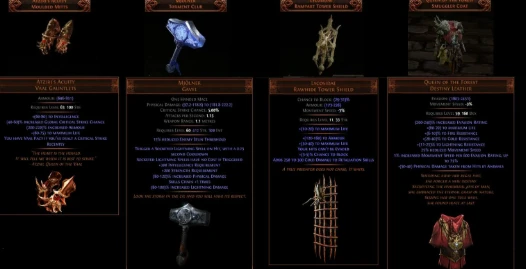
Unique (Orange) : A Unique item has fixed stats designed by the game developers. These items often have very special effects that can completely change how you play the game.
Understanding Prefixes and Suffixes — This Saves You Money
This part is very important. Every stat on an item is either a “Prefix” or a “Suffix.” A Magic item can have 1 Prefix and 1 Suffix (2 stats total). A Rare item can have 3 Prefixes and 3 Suffixes (6 stats total).
Here’s an example: On a sword, damage stats are usually Prefixes, while attack speed and resistances are Suffixes. You cannot put six damage stats on a sword because the game limits you to 3 Prefixes. Knowing this helps you avoid wasting currency on items that cannot be improved further.
What Are Implicit Modifiers? The Hidden Bonus on Your Gear
Some item types have a built-in bonus called an “Implicit Modifier.” This bonus is always there, no matter what rarity the item is. For example, a Topaz Ring always gives you Lightning Resistance. Currency orbs cannot change or remove this implicit stat. So when you pick up a good base item with a strong implicit, keep it — that built-in bonus is free power that no amount of crafting can erase.
Path of Exile 2 Item Currency — Your Real Tools for Power
Now we get to the most important part. In most games, you use gold to buy gear. In Path of Exile 2, Path of Exile 2 Item currency orbs are the real tools you use to craft and trade. Here are the ones you need to know:
Starter Orbs (Use These Freely)
-
Orb of Transmutation – Turns a White item into a Blue item with 1 random stat.
-
Orb of Augmentation – Adds a second random stat to a Blue item.
-
Orb of Alteration – Changes the random stats on a Blue item.
Mid-Game Orbs (Handle With Care)
-
Regal Orb – Turns a Blue item into a Yellow Rare item and adds 1 new stat.
-
Orb of Alchemy – Turns a White item directly into a Yellow item with 4 stats.
-
Chaos Orb – Removes one random stat from a Yellow item and adds another random stat. This is the main trading currency players use.
High-End Orbs (Keep These Safe)
-
Exalted Orb – Adds a new random stat to a Yellow item. This is one of the most valuable trading currencies in the game.
-
Divine Orb – Randomizes the number values on your item’s stats (for example, changing “20-30% increased damage” to a new number between 20 and 30).
-
Mirror of Kalandra – Creates an exact copy of a non-Unique item. This is the rarest and most expensive currency in the entire game.
How to Get Better Gear Without Getting Lucky
Many new players think you just have to wait for good items to drop. That is not true. Here are three reliable ways to get strong gear:
-
Craft from White bases – Pick up good white items with high item level and strong implicit mods. Use an Orb of Transmutation, then an Orb of Augmentation, then a Regal Orb, then Exalted Orbs to fill the remaining stat slots. This is often cheaper than buying finished gear.
-
Check vendors in town – Every time you level up, town vendors refresh their inventory. Their items scale to your level, so you can find surprisingly good Magic or Rare gear this way.
-
Disenchant unwanted items – Instead of selling everything for gold, take Magic items to the disenchant vendor to get Transmutation Shards, and Rare items for Regal Shards. Ten shards make one full orb.
Trading — How to Buy and Sell With Other Players
Trading is not optional in Path of Exile 2. It is how you survive the endgame. The trading economy runs on Exalted Orbs as the main currency. A well-rolled Rare item might cost 5 to 20 Exalted Orbs. A top-tier endgame item can cost hundreds of Divine Orbs.
To trade, you can use the in-game Market Panel (press the slash key “/” on PC) or the official Path of Exile 2 trade website. You can also talk to Ange, the Merchant NPC in your hideout, to list items for sale. When another player buys your item, the currency goes straight into Ange’s Earnings Tab — even when you are offline.
A Quick Word on Farming Currency
If you need Exalted Orbs, farm areas with lots of monsters. The Mines in Act 2 is one of the best spots before endgame maps because it has very high monster density. Stacking “item rarity” stats on your gear increases your chances of finding better loot, so try to get item rarity on your helmet, gloves, and rings


