












English


Guide
FC26 Tactics Worth Trying




I spent the first month of FC26 losing to the same thing. Every opponent ran a 4-2-1-3 with two holding midfielders sitting deep, the fullbacks on stay back, and three attackers who never tracked a single defensive run. The ball would bounce around the midfield, someone would hit a through ball to a 94-pace winger cutting inside, and my center back would be on the halfway line for no reason. I lost to this setup maybe twenty times before I accepted that my tactics from FC25 were not going to carry over.
That is the thing about tactics in FC. Every year the meta shifts. Sometimes it shifts because EA patches something. Sometimes it shifts because players figure out a new interaction between roles, or a formation that breaks the defensive AI, or a pressing pattern the engine cannot handle. And sometimes the shift is smaller than it looks. The formation that got you 14 wins last year might still work. You just need to adjust the roles inside it.
After enough experimenting, enough rage quits, and enough late nights tweaking sliders five minutes before Weekend League closes, I have landed on a few setups that actually hold up. Not meta-breaking stuff. Not the kind of tactics that YouTubers title "UNBEATABLE 24-0 FORMATION." Just setups that feel coherent, reward the way you actually play, and do not fall apart the moment your opponent switches to constant pressure. Here is what I have found after all those games: which formations still work and why, which ones surprised me, and a couple of tactical ideas worth borrowing for your own team.
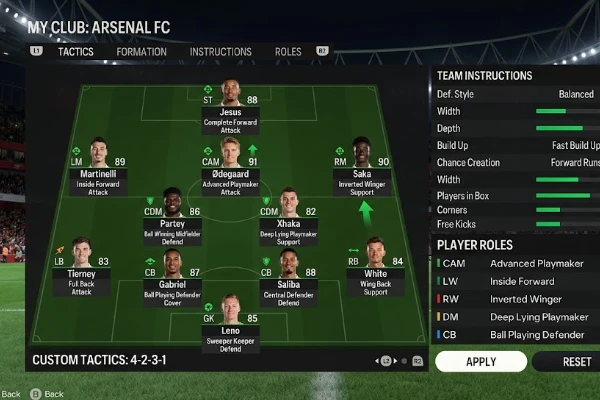
The 4-2-3-1 Narrow Is Not the Same Anymore
If you played FC24 or FC25 seriously, you probably ran some version of the 4-2-3-1 narrow. It was the default competitive formation for a reason. Two CDMs shielded the backline. Three CAMs overloaded the center. The striker stayed high. It was safe, compact, and hard to break down. For about three years, it was the formation you used when you needed a win and did not want to think too hard.
In FC26, the narrow 4-2-3-1 has a problem. The three CAMs no longer pinch in the way they used to. The central CAM drops deeper by default, which sounds like a good thing until you realize they are now occupying the same space as your more attacking CDM. Your build-up gets congested. Passes get intercepted. The width that used to come from your fullbacks now has to come from somewhere else, and the formation does not naturally provide it.
I tried the 4-2-3-1 wide as an alternative and it fixed most of these issues. The wide CAMs behave more like traditional wingers in the build-up phase but still drift inside when the ball is on the opposite flank. You get the width without sacrificing the central overload that made the narrow version good in the first place. The key adjustment is setting your fullbacks to balanced instead of stay back. With two CDMs already providing cover, one fullback pushing forward does not leave you as exposed as you would think. The formation naturally shifts into a 3-2-5 in possession, which is basically what every top team does in real football anyway.
The player roles matter more than the formation itself. I run the central CAM on Playmaker Roaming, the wide CAMs on Inside Forward, the striker on Advanced Forward, one CDM on Deep-Lying Playmaker Defend, and the other on Holding. The fullbacks on Balanced. This setup creates passing triangles all over the pitch without anyone occupying the same lane. It is the most consistent attacking shape I have used all year.
Three-Back Formations Are Not a Meme Anymore
Back in FIFA 22 and 23, running a three-back was basically asking to get countered. Your outside center backs would spread too wide, your midfield would leave gaps, and one through ball down the wing would put your opponent in on goal with your slowest defender trying to recover. It was suicide above Division 3.
FC26 changed that. The defensive AI in three-back systems is smarter about maintaining shape. The wide center backs stay narrower out of possession. The midfield drops into a flatter line when the ball is in your half. It is not perfect, but it is no longer the automatic loss it used to be. I have run the 3-5-2 and the 3-4-2-1 for extended stretches and both hold up better than I expected.
The 3-5-2 is the one I keep coming back to. The two strikers pin the opponent's center backs. The
midfield three gives you a numerical advantage against almost any two-man midfield. The wingbacks provide width without leaving you short at the back because you still have three center backs behind them. Against opponents who run narrow formations, the 3-5-2 is basically a counter. You outnumber them in midfield, you stretch them wide with the wingbacks, and you always have a free man somewhere.
The catch is the wingbacks. If you set them both to Join the Attack and your opponent runs a 4-3-3 with pacey wingers, you are going to get cooked on the counter. I run one wingback on Balanced and the other on Stay Back, which creates an asymmetrical shape that is harder for opponents to read. It also leaves you with three defenders plus one wingback when you lose possession, which is usually enough to slow down a counter long enough for your midfield to recover. The asymmetrical setup feels slightly wrong when you look at the tactics screen, but in game it flows better than the symmetrical version ever did.
The 4-4-2 Flat Is Better Than It Should Be
I wrote off the flat 4-4-2 in FC24 because it felt outdated. Two banks of four. Straight lines. No fancy roles. It looked like a formation from FIFA 15, and I assumed it would get torn apart by any modern pressing system. I was wrong.
What makes the 4-4-2 work in FC26 is how the two lines of four compress space without actually pressing. You do not need a complicated pressing trigger. The shape itself denies passing lanes because your players are positioned in two flat lines that cover the width of the pitch. Opponents trying to play through the middle run into eight players behind the ball. Opponents trying to go wide find your winger and fullback doubling up on their wide player within seconds.
I use the 4-4-2 when I am protecting a lead or playing against someone noticeably better than me. It is not exciting. You will not create ten chances a game. But you will concede fewer stupid goals, and sometimes in Weekend League, that is the entire difference between 11 wins and 9.
The key to making the 4-4-2 work offensively is the striker partnership. One target man, one get in behind. Do not run two strikers on the same role or they will stand next to each other and be marked by the same center back all game. The target man drops short, draws a defender out, and lays it off. The get-in-behind striker runs the channel. It is simple, but it works because the defensive AI in FC26 still struggles to track two strikers making opposite movements.
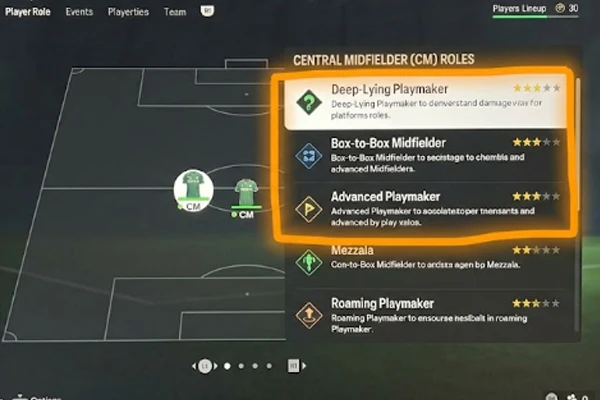
Player Roles Are the Real Formation
I used to obsess over formations. I would scroll through the 4-3-3 variants, try the 4-1-2-1-2 for a week, flirt with the 4-2-2-2, and eventually come back to whatever was working for everyone else. The formation felt like the most important decision I made before kickoff.
In FC26, player roles matter more than the base formation. A 4-3-3 with the wrong roles plays worse than a 4-4-2 with the right ones. The formation is just a defensive shape at this point. The roles determine where your players actually move when you have the ball, and that attacking shape is what defines how your team actually plays.
An example. I tried a 4-3-3(4) early on with a standard setup. CAM on Playmaker, wingers on Inside Forward, striker on Advanced Forward, CMs on Box-to-Box. It was fine. Nothing special. I switched the CAM to Shadow Striker, put the striker on False 9, and changed one CM to Playmaker Attack. Suddenly the same 4-3-3(4) played like a completely different formation. The False 9 dropped into the space the Shadow Striker vacated. The Playmaker Attack CM pushed into the half-space. The Inside Forwards had room to cut inside because the striker was not occupying the center backs anymore. Same formation on the tactics screen. Totally different team in possession.
If you are stuck with a formation that feels stale, do not switch formations. Switch roles. Change two or three of them and play five games before you judge. Sometimes a single role change on your defensive midfielder fixes issues you blamed on your whole backline.
Tactics Worth Stealing
I have picked up a few setups from opponents and content creators that hold up well. These are not my inventions. They are setups I have tested over enough games to trust.
- 4-2-4 with both fullbacks on Stay Back. On paper it looks like a glass cannon: four attackers, two midfielders, no attacking fullback support. In practice, the four attackers pin the opponent's backline so deep that your two midfielders have all the time in the world on the ball. The opponent cannot press high because four attackers waiting behind their midfield line is terrifying. One long ball over the top and you are through. It is not balanced. You will concede. But you will score more than you concede, and sometimes that is the math you need.
- 4-3-3(2) with a dedicated CDM. This is the safest setup I have found for tough matchups. CDM on Holding, one CM on Box-to-Box, the other on Deep-Lying Playmaker. Wingers on Inside Forward, striker on Advanced Forward. It is boring. It is also consistent. You will not get blown out. The CDM stays central and sweeps up everything in front of the back four. The CMs shuttle between attack and defense. The wingers cut inside and create. It is the formation I use in my first five Weekend League games every week while I figure out how the gameplay feels that day.
- 4-1-4-1 for possession-heavy play. The midfield four creates a box shape in possession that is almost impossible to press effectively because there are always two short passing options available. The lone CDM behind them provides insurance. The downside is that you need your striker to be a complete forward who can hold up the ball and bring others into play, because they will spend stretches of the game isolated. A pure poacher does not work here. You need someone like a Kane or a Haaland type who can receive the ball with his back to goal and bodies around him.
None of these three setups is perfect in every situation. The 4-2-4 scores goals but leaks them. The 4-3-3(2) is safe but unspectacular. The 4-1-4-1 controls games but needs the right striker to function. What they share is that each one has a clear identity. You know what you are getting when you load into a match, and in a game where the meta shifts every few weeks, that kind of consistency is worth more than chasing whatever formation the top players are running this week.
Defensive Depth and Why the Default Setting Is a Trap
The game defaults your defensive depth to 50. Most players leave it there. This is a mistake, and it took me until about November to figure out why.
At 50 depth, your defensive line sits in a zone that is high enough to leave space behind but not high enough to compress the midfield effectively. It is the worst of both worlds. You are not pressing. You are not parking the bus. You are just standing in no man's land waiting for a through ball to punish you. After watching a pro player's tactics breakdown, I tested a few alternatives and the difference was immediate. Here are the three depth approaches I have used across different setups.
- High line: 60 to 70 depth. This compresses the pitch and pulls your midfield closer to your defense. Passing lanes shrink. The opponent has less time on the ball because your players engage ten yards higher up the pitch. More turnovers in dangerous areas means more goals from transitions. The obvious fear is getting countered over the top, and yes, fast strikers will get in behind if you are not paying attention. But if you have a center back with at least 80 pace and you are decent at right-stick switching, the tradeoff is worth it. The extra goals you score from high turnovers outweigh the occasional long ball that catches you out. I run 65 depth on most of my attacking setups now and would not go back.
- Low block: 35 to 40 depth with Drop Back. Drop Back got nerfed in FC25 and people abandoned it, but in FC26 it is viable again as long as you pair it with a formation that has at least two midfielders sitting deep. The block stays compact and is genuinely hard to break down with patient build-up. The danger here is not the defensive shape itself but what happens after you win the ball. If your only plan is clearing it long, you are just giving possession back and waiting for the next attack. That is not defending. That is delaying. You need an outlet: a fast striker, a target man, or wide players who can carry the ball up the pitch. Without a transition plan, low depth just means you lose more slowly.
- Default 50 depth. I am listing it here because ignoring it would be dishonest. Most players never touch the slider. The game has been out for months and I still face opponents whose defensive line sits at 50 with balanced defensive style, and you can feel it within the first ten in-game minutes. The space between their midfield and defense is large enough to park a bus in. Their press is half-hearted because the triggers fire too late. If you are unsure where to start with depth, the simplest change you can make is moving it to 60 and playing five games. You will notice the difference. You might concede one or two more through balls, but your overall defensive shape will feel tighter and your midfield will actually participate in defending instead of jogging behind the play.
There is no single correct depth setting. It depends on your formation, your center back pace, and how comfortable you are defending in space. But the one setting that is almost certainly wrong is 50. It exists because EA needed a neutral default, not because it represents any kind of tactical sweet spot. Move it up or move it down, but move it somewhere with intention.
What I Would Tell Myself Three Months Ago
I spent way too long looking at high-rated opponents' tactics on FUTBIN and trying to replicate setups that made no sense for how I actually play. If you like to build up slowly through the middle, copying a pro player who spams through balls to 99-pace wingers is not going to make you better. It is going to make you frustrated.
The tactics that work best are the ones that fit how you already play. Not the other way around. Figure out whether you are a possession player, a counter-attacking player, or something in between, and build your tactics around that tendency. Borrow roles and ideas from setups you see online, but do not copy the entire thing and expect it to work for your playstyle. It usually will not.
One more thing. If you are losing games you feel you should have won, check your width settings. The default width on attack is 50. For narrow formations, that number should be higher. For wide formations, it should be lower. It sounds backwards, but narrow formations need width from somewhere and wide formations already have it. My 4-2-3-1 wide runs 65 attacking width. My 4-4-2 runs 40. Small adjustments that make a real difference over 90 minutes.
Not every tactic needs to be optimal. Some of them just need to be fun. That sounds obvious, but in a game mode that rewards wins above everything else, it is easy to forget that you are allowed to enjoy the process of building something that feels like your team rather than a meta spreadsheet. Try things. Break things. Copy what works and throw away what does not. The tactics screen is the most underrated part of FC26, and most players never spend more than thirty seconds in it before starting a match.
Looking back at the start of the year, I was running the same 4-2-3-1 narrow with the same instructions I used in FC24, losing to the same through balls over and over, convinced the game was broken. The game was not broken. I was just using outdated tactics in a new engine and expecting them to work. The formations and setups in this article are not a guarantee of anything. The meta will shift again. A patch will drop and suddenly the 3-5-2 will feel awful and everyone will be running a 4-3-3 Holding. That is just how this game works. The point is not to find the one perfect setup. It is to get comfortable adjusting, to pay attention to why something stopped working instead of just copying a new code from YouTube, and to treat the tactics screen as something you return to regularly instead of something you set once in September and forget about.


