











English


Gameplay
AION 2 Assassin Gameplay




The Assassin is a melee burst-type damage dealer in AION 2, wielding dual daggers as its weapon. The class is oriented toward single-target strikes and also possesses stealth capabilities. The core design revolves around positioning and short-window burst damage — the standard attack flow is to approach a target while stealthed, circle behind them, and unleash a flurry of dagger strikes before the enemy can react. The Assassin's single-target damage output ranks among the highest of all classes, but its limited attack range and weak defenses combine to create a very narrow margin for error: positioning cannot be careless, and every movement must serve either offense or disengagement.
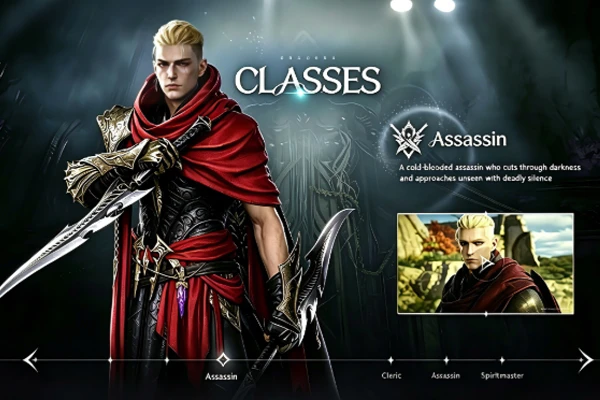
Class Identity: Melee Single-Target Burst
The Assassin's damage model is a classic melee burst type. Unlike sustained damage dealers, the Assassin's damage is concentrated into brief time windows — approach while stealthed, open from behind, chain rapid dagger attacks, and disengage before the enemy can retaliate. This flow places a higher demand on timing judgment than on continuous stand-and-deliver output. The high attack speed of dual daggers makes it possible to deal a large volume of damage within seconds, but the limited range means closing to point-blank distance is necessary to start the damage rotation. In group PvE content, the Assassin typically serves as a single-target burst specialist against bosses rather than an area-of-effect damage role for clearing groups of weaker enemies.
The Assassin’s fragile defense is an unavoidable trade-off. Light armor combined with a lack of effective self-sustain means the class has almost no ability to absorb focused fire. This characteristic in turn reinforces the importance of positioning — an Assassin's survival depends not on damage reduction stats, but on correct positioning and the discipline to avoid overstaying on the target.

Stealth and Flanking: The Core Attack Approach
Stealth is the standard prerequisite for an Assassin initiating an attack. Entering stealth, closing in on the target, circling behind, and then launching a combo — this flow leverages two advantages: first, the initiative granted by the stealthed state, and second, the potential bonus damage or additional skill effects triggered by attacking from behind. The purpose of flanking is not solely to maximize damage output, but also to buy the safe window of time before the enemy turns to face the attacker.
Worth noting is that stealth is not an infinitely sustained state — the timing of entering and exiting stealth directly affects the quality of every engagement. Revealing too early results in being locked down by the enemy before landing the opener; disengaging too late risks being caught by counterattack skills. In practice, the Assassin's stealth is used more for the initiation phase of a fight than for prolonged concealment.
Skill Ceiling: Low Margin, High Reward
The Assassin's margin for error ranks among the narrowest of all classes. Short attack range, fragile defenses, and heavy reliance on positioning — with these three factors combined, every movement in terms of both direction and distance must carry a clear purpose. Saying the Assassin "cannot position carelessly" is not a restriction, but a description of its operational nature: every movement either creates an offensive opportunity or eliminates a threat; there is no neutral state of simply standing somewhere. The flip side of this high barrier is a high ceiling. Among all classes, an Assassin played well is capable of delivering top-tier single-target damage. The Assassin's performance ceiling is determined by the player's positioning awareness and the precision of skill timing:
The route chosen for the stealthed approach determines whether the flank can be completed before the target detects the threat — the straight line is the shortest but the most likely to be spotted; circling around using terrain cover takes longer but carries a higher success rate.
The window for unleashing burst skills is extremely short, requiring the full combo to be executed immediately after reaching the flanking position. Any delay gives the target time to turn or retaliate.
Judging when to disengage is every bit as important as the engagement itself — pulling out of attack range before the enemy's counter-move begins is the only way to avoid absorbing damage with fragile defenses.
The Assassin is poorly suited to prolonged skirmishes against multiple targets. When facing multiple enemies, eliminating the isolated target first and using terrain to cut off reinforcement routes is far more effective than engaging head-on against the entire group.
The Assassin is a class with a high commitment cost — its damage ceiling is among the most impressive of all classes, but its survivability when played poorly is equally concerning. It suits players willing to invest deeply in positioning precision and skill timing, and who accept the premise that a single mistake means starting over. Those who enjoy the rhythm of closing in, bursting, and disengaging within seconds will likely find the Assassin to be the most rewarding damage dealer in AION 2.


