












العربية


Gameplay
How to Build the POE2 Passive Skill Tree?




In Path of Exile 2, the passive skill tree remains one of the core systems that determines a build's power ceiling. It not only affects basic attribute growth but also directly changes skill behavior and overall combat style. Many new players tend to make mistakes early on, such as randomly allocating points or focusing only on single-stat bonuses, which often results in insufficient damage, weak survivability, or an incomplete build in the mid to late game. In reality, the passive tree is a system built around path planning, build direction, and skill synergy.” Only by clearly defining your build identity first and then allocating points in stages can you fully unlock its potential.
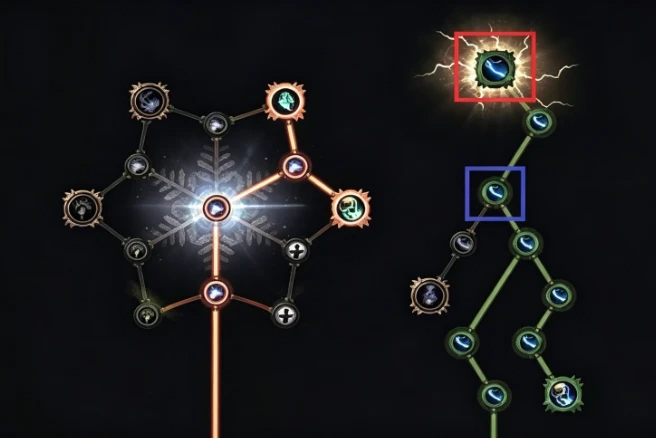
Passive Tree Fundamentals: Understanding Path First, Points Second
In POE2, the passive skill tree is not a simple stat-boosting system but a highly route-dependent structure where each path choice directly affects long-term development and build flexibility.
During actual progression, the following principles should be considered:
- The passive tree is a connected structure that requires route planning
- Attribute points are not about quantity but about build relevance
- Keystone nodes can completely change gameplay mechanics
- Path selection determines future gear scaling options
Many players don’t actually misplace points—they simply fail to plan their path early, which limits their late-game flexibility.
Early Game Strategy: Prioritize Survival Before Damage
During the early game, gear and levels are unstable. If players focus too heavily on damage nodes too early, they often suffer from inefficient clearing speed or frequent deaths. Building a stable defensive foundation first is essential.
A practical early-game approach includes:
- Prioritize life and elemental resistance nodes
- Ensure baseline damage is functional rather than burst damage
- Avoid entering complex branching paths too early
- Focus on general damage nodes instead of conditional effects
- Keep passive points flexible for later respec or adjustment
The main goal of early progression is not maximum DPS, but stable campaign and map clearing.
Build Planning by Archetype: Constructing Around Core Mechanics
The true value of the POE2 passive tree lies in building around skill mechanics. Different classes and playstyles require completely different passive allocations, so defining your build direction is essential before investing points.
Build planning typically follows these patterns:
- Physical builds prioritize attack scaling and critical nodes
- Spell builds focus on spell damage and cast speed
- Damage-over-time builds prioritize application and scaling mechanics
- Defensive builds focus on armor, evasion, or energy shield systems
The core idea is not to pick the strongest node, but to choose the most synergistic ones for your skill setup.
Mid Game Optimization: From Playable to Efficient
Once you enter mid-game progression, the passive tree shifts from basic survival support to efficiency optimization. This stage often determines mapping speed and overall farming effectiveness.
Key optimization focuses include:
- Replace low-value nodes to improve overall efficiency
- Adjust passive structure based on gear affixes
- Strengthen core damage loop mechanics
- Pick up movement- and clear-speed-related nodes
- Rebalance defenses for higher-tier content
The main objective here is to eliminate wasted points and maximize value per allocation.
Endgame Optimization: Fine-Tuning for Maximum Efficiency
In the endgame, the passive tree becomes a precision optimization tool rather than a basic progression system. Every single point matters and can significantly impact boss fights and peak performance.
Endgame optimization focuses on:
- Maximizing damage scaling around core skills
- Adjusting keystones for endgame boss mechanics
- Restructuring paths based on optimized gear
- Fine-tuning defenses against high burst damage
- Calculating the highest-value node combinations
At this stage, optimization is no longer about correct choices,but about “optimal choices.
In Path of Exile 2, the passive skill tree is not only the foundation of character progression but also the key system that defines build depth and the power ceiling. Copying builds without understanding their structure often leads to stagnation in mid-to-late game progression. Only by defining a clear build direction, planning paths carefully, and continuously optimizing alongside gear upgrades can players fully unlock the system’s potential. From early leveling to endgame optimization, every stage matters in shaping final performance. MMOM will continue to provide the latest POE2 build guides and Ascendancy strategies to help players develop stronger characters and achieve smoother progression across Wraeclast.


